

Vaccine Info Statements vs. Package Inserts
Federal law requires that every person, regardless of age, is given a Vaccine Information Statement for a selection of vaccines prior to vaccination.
A complete list of all available VIS can be found at https://www.immunize.org/vaccines/vis/about-vis
Originally, a VIS was intended to fulfill the requirements of the National Childhood Vaccine Injury Act of 1986. Based on a 1993 amendment, it was determined that a VIS must provide:
-
A concise description of the vaccine benefits
-
A concise description of the associated risks
-
A statement of the availability of the National Vaccine Injury Compensation Program
-
Other relevant information as may be determined by the Secretary
There is also information on each VIS about adverse reactions, and how they should be reported to the Vaccine Adverse Event Reporting System (VAERS).
Get more information about VIS from the CDC
Thie following is a VIS instruction sheet for healthcare providers.

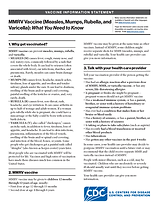
A sample to explore...
This is the MMRV VIS, updated Jan 31, 2025.
Explore all VIS available on immunize.org
We often hear from injured parties as well as healthcare providers that they were "unaware" of any type of injury reporting system associated with vaccines. Bearing that in mind, we must ask how many healthcare providers adhere to Federal Law to provide a VIS to vaccine recipients prior to vaccination, and is there any consequence for this breach in trust?
Unlike the simplified VIS, the package insert is a highly detailed multi-page document with important information on dosing, contraindications, safety trials, and post-marketing observations if available.
PDFs of package inserts are found at
https://www.immunize.org/official-guidance/fda/pkg-inserts
Even though package inserts are written in a technical language and are lengthy and can be difficult to understand, it is a good idea to look through them anyway because they list important information about the drug.
Key areas to review include:
-
Vaccine administration and storage instructions
-
Contraindications relative to your health, or prior vaccine reactions
-
Warnings and precautions
-
What adverse reactions may occur
-
What safety studies were done and for how long
A sample to explore...
This is the 28-page package insert for the ProQuad® Measles, Mumps, Rubella and Varicella Virus Vaccine Live Suspension for intramuscular or subcutaneous injection. Compare this to the 2-page VIS sample above.


Before You Vaccinate
Prior to the appointment, prepare any questions you may have for your healthcare provider about ingredients, efficacy, and storage requirements of your vaccine to ensure they were met (some vaccines need to be refrigerated).
At the appointment, your provider is required by Federal Law to give you a Vaccine Information Sheet (VIS) prior to administering the vaccine. Review the VIS with your provider.
If the vaccine is coming from a multi-dose vial, ask your provider if the bottle has been properly shaken prior to each draw, and which recipient or dose number you would be considered.
Before your appointment concludes, document the following additional details for yourself.
-
The lot number of your vaccine
-
Dose/recipient number (if a multi-dose vial)
-
Manufacturer name (brand)
-
Vaccine country of origin (e.g., U.S., China)
-
Expiration date
You might also be interested in:
